


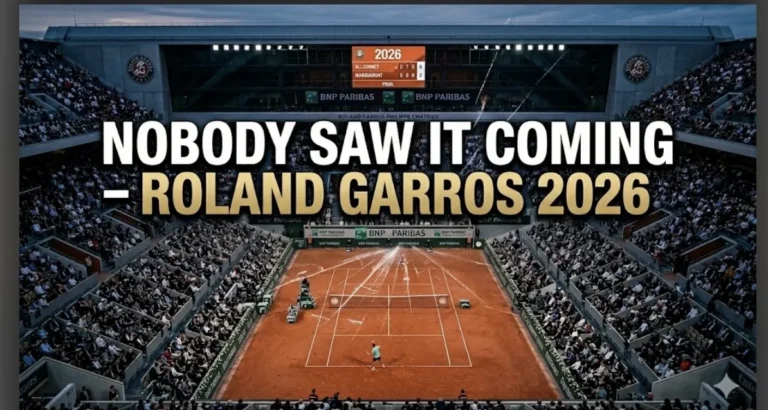
In the world of tennis, the French Open often defies expectations, but the 2026 edition shattered all norms. Outside of Rafael Nadal’s impressive legacy, this year’s tournament became a whirlwind of surprises and unexpected outcomes.
A staggering fifteen seeded players were eliminated in the first round, including three from the men’s top ten and Jessica Pegula, the usually reliable No. 3 seed among the women. Following a predictable Australian Open, Paris turned the tables with only Alexander Zverev and Aryna Sabalenka, the top eight seeds, advancing to the quarterfinals. This marked a historic first in the Open Era, as no previous men’s Grand Slam champion made it to the round of 16.
The women’s draw showcased the most dramatic twists, as Maja Chwalinska, ranked No. 114 and a qualifier, surged to the final. Iga Swiatek, her former junior doubles partner and a favorite with a 30–3 record at Roland Garros since 2020, fell to the 15th-seeded Marta Kostyuk in the fourth round, ensuring a new champion. Meanwhile, world No. 1 Aryna Sabalenka was upset by the left-handed Diana Shnaider, and defending champion Coco Gauff exited prior to the semifinals. Russian teenager Mirra Andreeva continued her impressive ascent, defeating Kostyuk, whom she had lost to twice earlier in the season.
Maja Chwalinska’s journey was nothing short of a fairy tale as she advanced to the finals, defeating an Olympic champion and three seeded players while only dropping one set. She became the first qualifier in 125 years to reach the French Open final. Her unique style, featuring left-handed backhand slices and powerful topspin forehands, disrupted the rhythm of seasoned players like Maria Sakkari, Elise Mertens, and Anna Kalinskaya. Chwalinska remarked, “I know I’m playing different tennis than most of the girls on tour. I don’t have the conditions to play strong, so I need to develop different weapons. I just try to change the rhythm a lot. I feel like it’s pretty tough to play against this kind of style, because you don’t have any rhythm — every ball can be different.”
Her friendship with Swiatek dates back to their junior days, where they debuted professionally together in 2015. Having finished as runners-up at the 2017 Australian Open junior doubles, Chwalinska reflected, “Iga and I have a lot of history in common,” While Swiatek has clinched four Roland Garros titles, Chwalinska faced her own challenges, including a year away from the sport due to depression. A Polish company that sponsors Swiatek stepped in to cover her hotel expenses during the tournament when funds ran low, as her earnings of $1.6 million were only issued after the final match.
In a dramatic conclusion, Andreeva, at just 19 years old, captured the Coupe Suzanne Lenglen after displaying exceptional patience and capitalizing on every opportunity against Chwalinska, becoming the youngest champion since Monica Seles won at 18 in 1992.
The 2026 tournament was also marked by extreme weather conditions. The unprecedented heat and wind often overshadowed the players themselves. France recorded its hottest May ever, with temperatures soaring 10–15°C above average starting May 24, the tournament’s opening day. The heatwave peaked on May 26, setting a record for the hottest May day in French history. This climate anomaly, described by scientists as a one-in-1,000 occurrence, contributed to the early exits of notable players like Jannik Sinner and Novak Djokovic. With Carlos Alcaraz absent, it also marked the first time in the Open Era that no former major champion reached the round of 16 at a Grand Slam. The chaos led to unusual matchups, such as the quarterfinal clash between Matteo Berrettini and Matteo Arnaldi, both ranked outside the top 100, a first since 1991.
Officiating also drew attention, particularly during João Fonseca’s upset of Casper Ruud. A controversial moment in a second-set tiebreak sparked confusion over whether to replay a point, leading to a shift in momentum that affected the match’s outcome. Tournament director Amélie Mauresmo later defended the decision to retain human line judges, asserting that electronic systems are “We went through a lot together and it brought us together.” This incident was particularly notable given that other major tournaments, including the US Open and Wimbledon, utilize electronic line-calling across all courts.
Roland Garros 2026 not only crowned two new champions but also highlighted the unpredictability inherent in the sport, especially amidst climate challenges. The coming grass season raises questions: will Sabalenka, Gauff, and Swiatek rebound? Can Zverev finally secure a Grand Slam title? This year’s tournament in Paris was a whirlwind of chaos, proving that anything can happen, and dreams can indeed come true.